US' Section 301 probe against India, 15 more countries: Explainer
Initiation of the Section 301 probe against 16 countries marks a significant escalation in trade scrutiny.
PTI
-
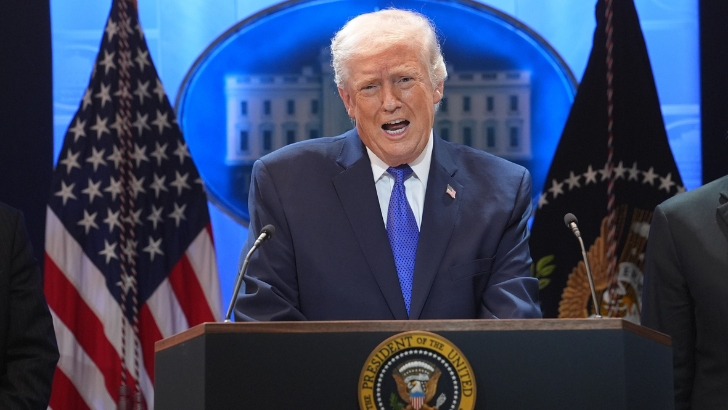
US President Donald Trump had announced 10 per cent tariffs on all countries for 150 days from 24 Feb (PTI)
New Delhi, 12 Mar
The US Trade Representative (USTR) on 11 March said it has
launched a fresh round of Section 301 trade investigations targeting policies
and industrial practices of 16 economies, including India and China.
Following a decision of the US Supreme Court striking down sweeping tariffs of the Trump administration, US President Donald Trump has
announced 10 per cent tariffs on all countries for 150 days from 24 February.
Now, initiation of this probe marks a significant escalation
in trade scrutiny. Here are a few questions and answers to understand the
issue.
WHAT IS THIS
INVESTIGATION?
The United States Trade Representative (USTR) has announced
that it has initiated investigations against its trading partners, including
India, China, Japan, and the European Union (EU), to look into and address
unfair foreign practices that are adversely affecting American manufacturing.
The probe targets policies and industrial practices of 16
economies.
The probe covers sectors, including steel, aluminum,
automobiles, batteries, electronics, chemicals, machinery, semiconductors, and
solar modules.
WHICH 16 ECONOMIES
ARE COVERED UNDER THE PROBE?
There are 15 countries and the 27-nation EU bloc. The
nations are China, Singapore, Switzerland, Norway, Indonesia, Malaysia,
Cambodia, Thailand, South Korea, Vietnam, Taiwan, Bangladesh, Mexico, Japan,
and India.
WHY THIS PROBE?
After the US Supreme Court struck down tariffs imposed bythe Trump administration, he signed a proclamation to impose a temporary import
duty of 10 per cent on all countries to replace the tariffs invalidated by the
Court. After that, the President had stated that the US has other alternatives
to impose such levies.
On 20 February, a White House Fact Sheet stated that the
President has directed the Office of the USR to use its Section 301 authority
to investigate certain unreasonable and discriminatory acts, policies, and
practices that burden or restrict US commerce.
WHAT IS THE
INVESTIGATION PROCESS?
Under Section 301 of the US Trade Act of 1974, the US
government may investigate whether foreign trade practices are unreasonable or
discriminatory and harm American commerce.
The investigations will determine whether those acts,
policies, and practices are unreasonable or discriminatory and burden or
restrict US commerce.
"The probe will examine whether policies such as
industrial subsidies, state-supported manufacturing expansion, activities of
state-owned enterprises, market-access barriers, currency practices or
suppressed domestic demand have contributed to global manufacturing overcapacity
that burdens US commerce, think tank GTRI said.
If such practices are confirmed, Washington may impose
retaliatory trade measures, including additional tariffs, quantitative
restrictions or other trade barriers.
According to the GTRI, as per a defined process, public
dockets for written submissions will open on 17 March, allowing companies,
trade groups and governments to submit their comments on the probe.
Written submissions and requests to participate in hearings
must be filed by 15 April. Public hearings will take place from May 5-8 at the
US International Trade Commission in Washington. Rebuttal submissions must be
filed within seven days after the hearings conclude. After consultations with
the governments concerned, the USTR will determine whether the practices under
investigation warrant retaliatory action.
WHAT DOES THIS MEAN
FOR INDIA?
The Global Trade Research Initiative (GTRI) stated that the
US investigation identifies several sectors in India where structural excess
capacity or export surpluses may exist. These include solar modules,
petrochemicals, steel, textiles, health-related goods, construction materials
and automotive products.
According to the US notice, India's solar-module
manufacturing capacity is already nearly three times domestic demand,
suggesting the possibility of export-driven production surpluses. Similar
concerns are raised about expanding capacity in petrochemicals and steel, GTRI
Founder Ajay Srivastava said.
Apex exporters' body FIEO said the investigation seems
largely aimed at addressing global concerns around structural overcapacity in
manufacturing.
"India's export growth is largely demand-driven and diversified, so we do not see any immediate concern, though the situation will need to be watched," FIEO Director General Ajay Sahai said.
Share Now

Leave a Reply
Your email address will not be published. Required fields are marked *
Other Stories